From the field archive

Fingerprints at Boncuklu: looking closely at clay

An updated explanation of a historical project story about Lori Hager’s fingerprint research and reflectance imaging.

A historical research story

The earlier Boncuklu website introduced Dr Lori Hager’s work on fingerprints preserved on clay objects. The account survives in an archived snapshot captured on 12 November 2020. That is the capture date, not a verified original publication date. Its image paths associate the material with the project’s 2014 uploads. This page provides a new explanation of the subject rather than silently presenting the old field notice as current news.

A fingerprint impression can bring the making or handling of an object into focus. It is a physical trace, but it does not arrive with a name, social role or complete biography attached. The first questions concern what is preserved, the object’s context and how the surface can be examined consistently.

What RTI does

Cultural Heritage Imaging explains Reflectance Transformation Imaging, or RTI, as computational photography using a fixed camera and photographs made with light from different directions. A model of reflectance lets a reader change virtual illumination and enhance surface detail. It is not, by itself, a complete geometric 3D mesh that can be freely viewed from every side. A static enhanced image is one rendering of that model, not the full interactive dataset.

Seeing a trace is not identifying its maker

The historical story linked ridge observations with questions about who made the impressions. An updated account should keep those as questions requiring a documented analytical basis. This page does not assign a definite sex or age to an individual print, and does not repeat the earlier promise that a simple visual inspection would resolve every case. Preservation, measurement and comparison must be considered before an interpretation is reported.

How to read an enhanced image

Compare ordinary colour with an enhanced view and note which features become easier to see. Enhancement can assist observation, but the interpretation still needs the original object record and an explanation of the method. A colour-coded normals view should not be mistaken for the object’s original colours.

For a broader framework, read evidence and interpretation and early clay technology. The connection is practical: an object can preserve evidence of manufacture, handling and later processes, and each deserves a distinct question.

Sources and further reading

  1. Fingerprints at Boncuklu — archived snapshot, 12 November 2020
  2. Cultural Heritage Imaging — Reflectance Transformation Imaging
  3. Boncuklu Höyük: The earliest ceramics on the Anatolian plateau
  4. Early Ceramics in Anatolia: The Evidence from Boncuklu Höyük

Source review: 15 October 2026. Historical observations and current interpretations are distinguished in the text.
Read the scale before measuring a mark in a photograph

A photograph can make a clay impression easier to see without supplying a valid measurement. Start with the image’s scale, capture conditions and object record. RTI changes virtual illumination to reveal surface detail; it does not automatically make an enhanced view a geometrically calibrated three-dimensional measurement.

A complete numerical teaching example

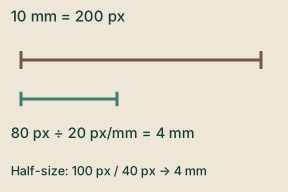
The diagram below contains only abstract lines and numbers, not a photograph of a Boncuklu object or a reconstructed fingerprint. Suppose an exercise image shows a 10 mm scale bar spanning 200 pixels. A marked segment on the same plane and in the same unaltered image spans 80 pixels. Under those stated assumptions, the image scale is 200 / 10 = 20 pixels per millimetre, so the segment corresponds to 80 / 20 = 4 mm.

  1. Check the scale’s identity: confirm that the 10 mm label belongs to this image and object. A ruler in another photograph or an unlabelled black rectangle cannot calibrate the view.
  2. Keep the plane and geometry: the simple ratio assumes the bar and segment are represented at the same scale. Perspective, an oblique surface or lens distortion can invalidate that assumption. Leave the measurement unresolved when the required capture evidence is absent.
  3. Handle resizing consistently: after uniform resizing to half width and height, the bar spans100pixels and the segment40. The ratio still gives4mm. Stretching only one axis or copying the bar separately breaks that consistency.
  4. Preserve the limited conclusion: the arithmetic describes the chosen segment in a constructed image. It does not identify a maker, age, sex, ridge density or biological trait. A real analysis needs the documented measurement method and uncertainty.

Record what you can and cannot claim

Completed exercise: source=synthetic diagram; bar10mm/200px; segment80px; plane assumed common; result4mm; uncertainty not supplied; biological interpretation not attempted. Without a known bar length, write “physical length not established” instead of guessing from screen size.

Copy: object/context identifier ___; original image/source ___; scale label and endpoints ___; segment endpoints ___; pixel measurements ___; shared-plane evidence ___; resizing or enhancement ___; calculation ___; uncertainty/limitation ___; interpretation still requiring evidence ___. Retain the historical authors and dates of the Boncuklu story separately from this new teaching exercise.

An abstract ten-millimetre scale bar spans two hundred pixels; an eighty-pixel segment on the same assumed plane corresponds to four millimetres. Halving both pixel lengths preserves the result. The diagram is not an archaeological object or fingerprint.
Original abstract measurement exercise, not a find photograph or analytical result. © Boncuklu Höyük · CC BY 4.0.

Cultural Heritage Imaging · Reflectance Transformation Imaging